
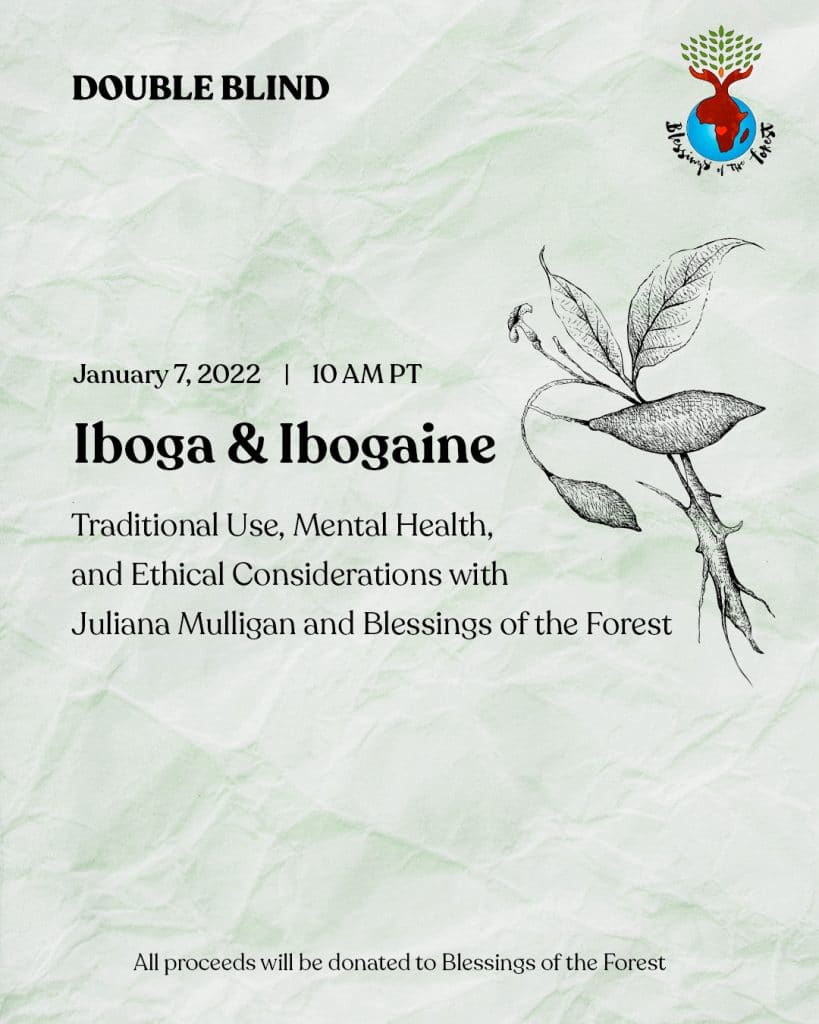
All proceeds from this event will be donated to Blessings of the Forest.
About the Speakers

Yann Guignon is a Franco-Gabonese consultant in Intercultural Mediation & Sustainable Development (Cabinet “Traits d’Union”). He has been initiated into iboga since 2004 and into Bwiti since 2006, in the rigorist branch of Mboumba Eyano of Master Atome Ribenga. In 2007, he was also taken under the wing of Professor Jean Noël Gassita, dean of world research on iboga(ïne). Under the direction of the Professor, Yann wrote a report on the “State of Knowledges about Iboga in Gabon and Internationally, which was submitted to all the Gabonese authorities, from the president to traditional healers in each branch of the Iboga tradition. As a result of his work, Gabon became the first country in the world to adopt the Nagoya Protocol, a protocol designed to ensure Indigenous reciprocity. Yann Guignon, along with David Nassim, founded “Blessings of The Forest” (BOTF), first in England in 2015 for the financial mediation structure and then in Gabon in 2018 as an NGO for the implementation of projects of “Conservation, Studies and Ethical and Sustainable Valorization of the Gabonese Cultural and Natural Heritage” in accordance with the principles of the Nagoya Protocol. In 2019, BOTF manages to adopt, by vote in the Council of Ministers, a decree “prohibiting the export of iboga from the Gabonese public domain for conservation purposes.” In 2020, BOTF signed an agreement with the Ministry of Water and Forests of Gabon to develop a fair and sustainable iboga industry in accordance with Nagoya. Since 2017, BOTF has been financing and technically supervising village community projects in Gabon, whose common pillar is iboga, through public interest agreements that promote the creation of income-generating activities for all the villages supported. Finally, Yann collaborates very closely with the NGO “Conservation Justice,” a leader in the fight against the trafficking of fully protected plant and animal species in Gabon. BOTF positions itself as an alternative to poaching by creating sustainable sources of income for villagers impacted by the human-wildlife conflict, inspired by iboga conservation and fair promotion.

Marie Lou Miboka Aboghé is a Gabonese (Akele/Fang) state nurse, and President of the NGO Blessings Of The Forest Gabon. Marie Lou is part of a large traditional Bwiti family of the Ngonde branch and initiated in this rite. She is particularly committed to the role of women in village agriculture and the education of children. She ensures that BOTF funding benefits both men and women in Gabon and encourages women to develop income-generating activities that will allow them to become financially independent. Finally, she supervises the development of health clinics that BOTF finances in villages where agro-forestry activities are carried out around iboga.

Juliana Mulligan has been an active member of the ibogaine community for nine years and is currently working on her MSW at NYU. She is the Psychedelic Program Coordinator at the Center for Optimal Living and currently runs Inner Vision Ibogaine, which supports people in preparation and integration around ibogaine treatment. She has worked in three ibogaine clinics, completed Andrew Tatarsky’s IHRP training, has presented at multiple Psychedelic and Harm Reduction conferences, and is the co-founder of The Root Ibogaine Collective. Previously Juliana was an opioid-dependent person and in 2011, with the help of Ibogaine treatment, she left opioids behind and set off on a path to transform the way drug users and their treatment is approached. She has taught about ibogaine at Charite University in Berlin and Southwestern College in New Mexico. Her writing has also been featured in the online publication Chacruna.

David Nassim is co-director and co-founder of Blessings of the Forest. He focuses on Indigenous rights advocacy associated with iboga and fundraising in the international arena. His background has been in Chinese medicine for over 20 years, culminating in consultancy and the teaching of health energetics. He has a special interest in psychotropic plants, and raising awareness of Indigenous people’s energetic understanding of their own herbal medicine heritage. He feels that reciprocity is vital and that Indigenous cultures are key in the use of ancient medicinals. To truly benefit from these practices, he feels we must accurately bridge their understanding to modern world issues, especially when shaping safe-practice.
You might also like:

DoubleBlind Tote Bag
$29
How to Grow Mushrooms Bundle
$219.99

On Shrooms And Having A Great Time Boxer Briefs
$29